Check the plant part, not just the name
Coriander is Coriandrum sativum. The RHS describes both its aromatic leaves and the fruits used in cooking. The dried fruits are commonly sold as coriander seeds. That terminology is not a reason to reject a product labelled “seeds”; the useful distinction is knowing which part of the plant your recipe actually calls for.
Look for “whole”, “seed”, “ground” or “leaf” on the packaging. Read the ingredients too: a spice blend containing coriander does not automatically replace pure coriander. Choose a product intended for food use. A packet of seed for sowing from a garden shop is not a substitute for a culinary spice, and a photograph of similar seeds cannot establish their identity.
Do not expect identical aromas
McCormick describes the seeds as mild, sweet and citrus-like, distinguishing their flavour from the leaves. Treat that as a tasting clue, not a guarantee that every packet will smell identical. If you mainly know coriander as a green garnish, assess a seed infusion separately rather than assuming it will give the same impression.
For your first attempt, do not replace a teaspoon of seeds with a teaspoon of chopped leaves. That changes the ingredient, its form and the way it is measured at the same time. Treat a leaf-based recipe as a separate combination. Use your own tasting words, such as “citrusy”, “herbal” or “faint”, without forcing your verdict to match the manufacturer’s description.
Whole, lightly crushed or ground?
Whole seeds make the product form apparent, although appearance still does not replace a label. When a recipe asks for light crushing, use a clean mortar to break them into coarse pieces. There is no need to turn them into powder. Prepare only the portion for the current brew and keep the rest in its labelled container.
Ground coriander is another form of the spice, not dried coriander leaves. Fine powder can pass through a strainer and remain in the drink, making filtration part of the preparation. Do not simply pour it into a recipe written for whole seeds. Check which form the author uses and whether the directions account for straining small particles.
Start with the orange recipe
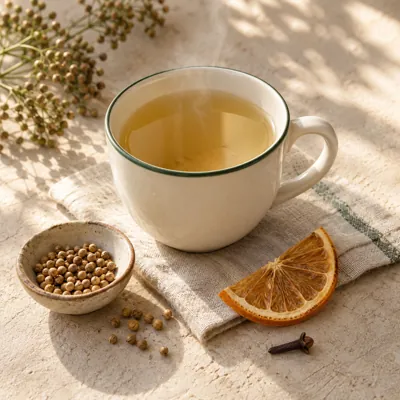
The public “Coriander and orange” recipe combines ¼ teaspoon of lightly crushed seeds, a slice of food-grade dried orange and one clove with 250 ml of freshly boiled water. It calls for a covered eight-minute steep followed by thorough straining. Those quantities belong to that particular combination, rather than being universal instructions for every blend containing coriander.
Keep the complete recipe unchanged at first to establish a clear reference. Have the strainer ready before pouring and let the drink reach a comfortable temperature before tasting. Orange and clove also shape the result, so do not attribute the entire aroma to the seeds. The illustration depicts this combination; it is not a guide to identifying wild plants or deciding whether they are edible.
Record the result and keep the label
Note the product name, spice form, how you crushed it, water quantity and steeping time. Next time, change no more than one element, perhaps the coarseness of the pieces, while keeping the others steady. If you alter the orange, clove and coriander quantity simultaneously, it becomes harder to explain why the flavour changed.
Keep the original label and storage directions. If transferring the spice into a jar, write “coriander seeds” or “ground coriander” instead of simply “coriander”. Label and store fresh leaves according to their packaging. This trial is about flavour and brewing convenience; it does not establish a medicinal dose or the suitability of an unknown ingredient.
Frequently asked questions
Does cilantro mean coriander seeds?
Cilantro usually refers to the fresh green part, especially in American recipes. The seeds are a different part of the same plant. Check the ingredient wording in the recipe rather than replacing one with an equal volume of the other.
Must I toast the seeds before brewing?
Not for the public Napar recipe described here: it calls for light crushing without toasting. Toasting would introduce another flavour change. Follow the selected directions for your first attempt and assess another method as a separate variation.
Educational and culinary content. It does not confirm the edibility of wild plants or guide medical treatment.
RHS · Coriander: leaves and fruits