Describe what you can actually see
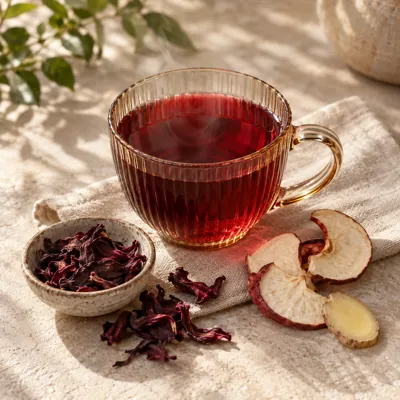
Look at the infusion in a clean, transparent vessel against a light background. Distinguish pieces of leaves or fruit, fine sediment at the bottom, and uniform cloudiness without visible fragments. These are descriptions, not diagnoses of the cause. Also note whether particles were present immediately after straining or became noticeable only after stirring.
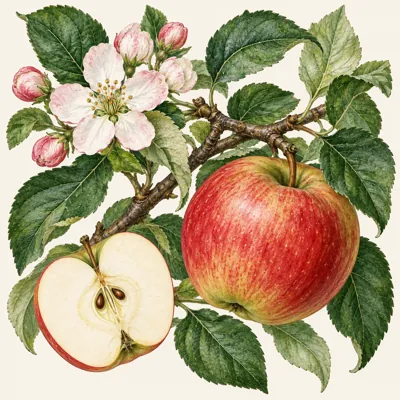
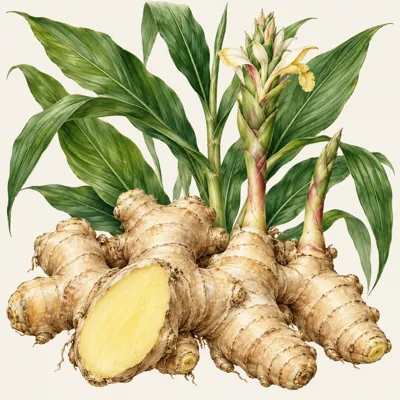
The red colour of hibiscus is not the same thing as suspended plant fragments. The photograph shows a hibiscus, apple and ginger composition, not a filtration experiment. A strainer holds back solids. Do not expect it to remove the infusion’s colour or every kind of uniform haze, and do not interpret an absence of sediment as a quality guarantee.
Check the mesh, closure and rim
After emptying and washing the infuser, inspect it against the light. Check the mesh, the seam between a tea ball’s halves, its hinge and the fastening. Fine mesh cannot catch fragments that bypass it through an open gap. With a basket, check whether ingredients spill over the top while you pour. Replace damaged parts according to the manufacturer’s instructions.
Match the filter to the actual size of the ingredients. Large holes may work for whole pieces but not for dust. Finum describes its basket’s stainless steel micro-mesh as suitable for herbs as well. This illustrates one construction; it does not establish that every metal filter performs identically. Check the cleaning instructions for your particular model, too.
Drain without crushing the wet blend
Brew a portion following the product directions or your chosen recipe. Once the required time has passed, lift the basket and let the liquid drain gently into the vessel. Do not press wet fruit through the mesh with a spoon. Crushing it makes comparisons harder, changing both the liquid squeezed out and the fine fragments entering the cup.
If you brew loose ingredients in a pot, support a strainer securely above a second vessel and pour slowly. Keep the stream within the filter, rather than around it or over its rim. Pause if it cannot drain quickly enough. Do not hold a wet, hot filter between your fingers over a cup; use a suitable holder.
Try a second filter on part of the infusion
Divide the freshly strained drink into two similar portions. Leave one unchanged and pass the other through a clean, finer food filter intended for hot drinks. A paper tea filter is one option; Finum supplies these for cups and pots. Fit it as directed rather than substituting a paper towel or tissue.
Compare the visible particles after the same short interval, using similar vessels and lighting. If the filter clogs, stop instead of squeezing or puncturing it. Less sediment is a result for this particular trial, not a promise of perfect clarity. A filter may retain some liquid, so consider ease of use and the resulting serving size as well.
Record the result and the method’s limits
Note the blend, water quantity, brewing time, filter and how you removed the wet ingredients. Change just one thing in the next batch, such as the tea ball’s closure or a second filter. If only one blend causes difficulty, examine its particle size and manufacturer’s directions before replacing all your equipment.
Appearance and smell cannot establish food safety; the FDA notes that harmful microorganisms may produce no noticeable signs. Do not rescue a questionable drink by filtering it. Here you are assessing only the drinking texture of a fresh infusion. If ingredients, storage or the origin of foreign fragments are unknown, straining alone will not explain the problem.
Frequently asked questions
Will a finer filter always remove cloudiness?
No. Visible fragments and uniform haze are different observations. A filter has particular particle-retention capabilities and may not remove everything that changes the liquid’s appearance. A home comparison shows only the effect on that portion.
Should I filter the whole pot again?
Compare two small portions first. If the extra straining gives the result you want and the filter works properly, use the same method for the rest of the fresh infusion. Do not leave the ingredients steeping longer while you carry out the comparison.
Educational and culinary content. It does not confirm the edibility of wild plants or guide medical treatment.
Finum · A micro-mesh brewing basket example
Finum · Paper tea filters and their intended use