First, check whether the ingredients match
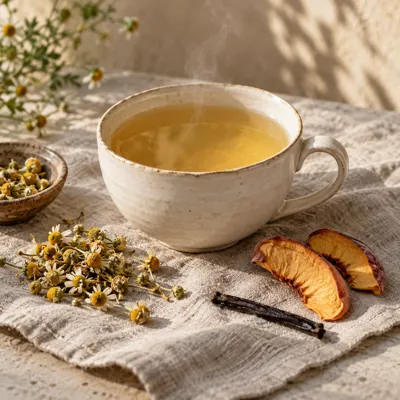
Plain chamomile and chamomile blended with peach are different drinks, even if both boxes feature a large flower. Compare complete ingredient lists, including fruit, other herbs and flavourings. The photograph illustrates Napar’s public chamomile, peach and vanilla recipe; it does not represent an equivalent of every chamomile bag.
To assess convenience, choose products that are as similar as possible, ideally containing a single ingredient. If the blends differ, you can still decide which drink you prefer, but your verdict concerns the whole products. Do not attribute every flavour difference to the presence of a paper or mesh filter.
Piece size is not a quality verdict
Bags do not necessarily contain only finely cut ingredients: teapigs lists whole flowers in its bagged chamomile. Twinings also explains that its loose and bagged tea versions can differ in leaf size. These are product examples, not a rule for every brand or herb.
Use the information on the pack and your experience of the drink. A large fruit piece may look appealing, but its appearance does not tell you whether the blend suits your taste. Avoid cutting a bag open simply to recreate a loose version: you would also change the straining method and no longer assess its usual use.
A serving means more than one bag
Check the water volume specified for a serving and the quantity recommended by the producer. One bag is not a universal equivalent of one teaspoon. When comparing weights, use the stated contents rather than the weight of a wet bag or its outer paper envelope.
For example, a 40 g pack containing 20 equal bags averages 2 g of contents per bag. This is an arithmetic example, not a serving recommendation. With loose ingredients, record the amount actually used and the water volume. A large mug with one bag and a small cup with a full basket are hard to compare without those details.
Follow each product’s preparation instructions
Use the same water and similar clean vessels, while keeping the required preparation method for each product. Do not shorten one product’s recommended brewing time merely to make both timers finish together. If instructions differ, record that difference as part of your comparison.
Remove the bag or strain the loose ingredients after brewing. Leave out lemon and sweeteners for the first assessment. Taste both at a similar, comfortable temperature and note aroma, flavour and particles. If the results differ greatly, check the serving size and water before deciding that the format caused it.
Include clean-up and the cost of your serving
With bags, consider how easily you can remove the filter and where to put it when wet. With loose ingredients, include measuring, catching small particles and washing the basket. Convenience may matter most at work, while you may value flexibility more at home.
Calculate cost using the amount you actually brew, rather than comparing box prices alone. For loose ingredients, divide pack price by pack weight and multiply by your serving weight. For bags, account for how many you use per mug. Do not assume an extra steep in the calculation unless the product allows it. Choose the option that suits both your taste and daily routine.
Frequently asked questions
Are loose herbal infusions always better than bags?
The format alone cannot establish that. Compare ingredients, portion, preparation and the finished drink; different products can give different results.
Can I steep both products for the same time?
Only if that matches both sets of instructions. Otherwise follow each product’s directions and record the difference instead of changing the required preparation for the test.
Educational and culinary content. It does not confirm the edibility of wild plants or guide medical treatment.